I am a perfectionist…
I am a MASSIVE perfectionist.
When you are a perfectionist, everyone tries to help by saying ‘perfection isn’t attainable’, ‘nobody’s perfect’, ‘it’s already perfect’, and other well-meaning but somewhat useless phrases. But here in Human Behaviour for the Mathematically Minded, I am going to try to look at and explain perfection in a different way.
So when we think about the pursuit of perfection, we generally think of it as quite a simplistic, linear relationship. As time and practise of a skill (t) increases, our ability (a) increases, until eventually we reach a point where a= Perfection (p), at which point the graph plateaus.
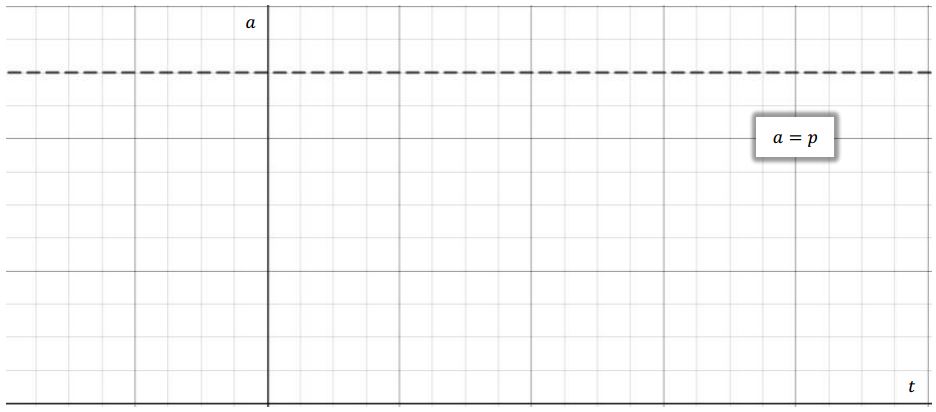
There are many flaws to this model; the idea that we can reach a point of absolute perfection and then we stop, is not at all realistic. Firstly, we need to consider what is ‘perfection’. Now without going in too deep about how it is an abstract construct, perfection is the absence of any flaws. I will explain why later in this article, but for the time being, lets accept that ‘perfection’ is not attainable. So mathematically speaking, perfection is an asymptote; we can get closer and closer, but we can never actually reach it. So our asymptote of a= p is shown below.
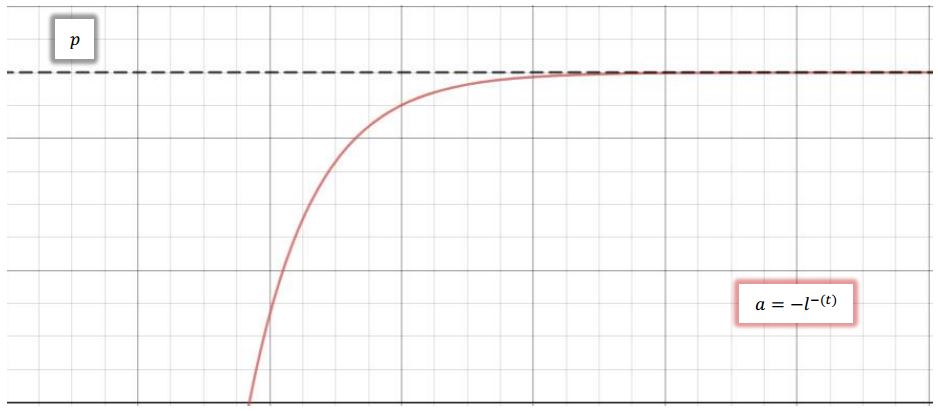
Now, instead of the pursuit of perfection being a linear increase in ability over time, this is better represented by an inverse exponential (logarithmic) growth curve. So, as time and practise increase, ability does indeed increase; but the rate of increase decreases. When learning a new skill in pursuit of perfection, in the initial stages our ability will increase quickly. We rapidly pick up lots of knowledge and simpler skills and become more and more able. But the more able we become the slower our rate of improvement. Once the gross facets of a skill have been learnt, what remains are the finer elements that are harder to learn and require much more practise and tuning. We can graph this out as shown below, including our asymptote (a=p)
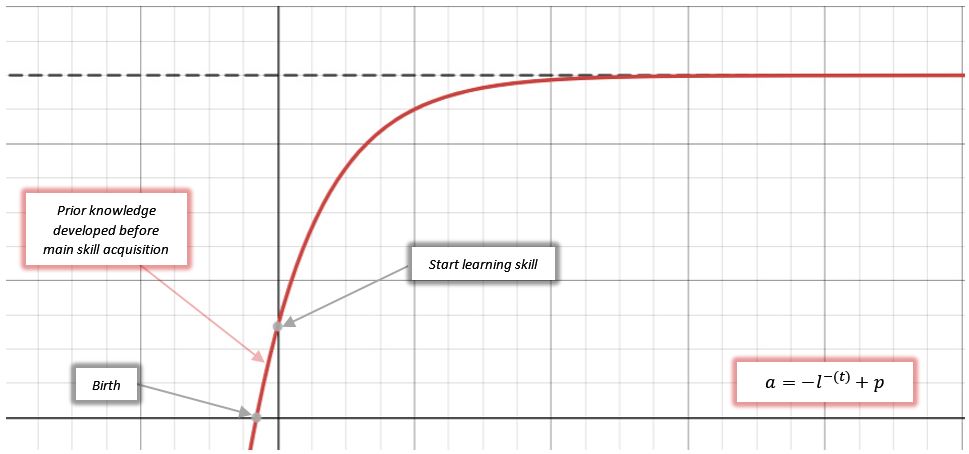
Still with me? So lets introduce our axes and limits. We can’t have ‘negative ability’, so we will only be paying attention to the area where a≥0. However, I am not going to constrain this graph such that t>0. Almost every single skill we learn and then aim to perfect is predated by some prior learning or innate reflex. If t=0 is the point at which we start to ‘actively’ learn a new skill, anything in the region of t<0 is ‘prior knowledge’. So if I was aiming to do the perfect star jump, I would start learning to do that at t=0, but prior to that, I will already have some ability such as the ability to stand upright, the ability to correct my balance or the ability to jump.
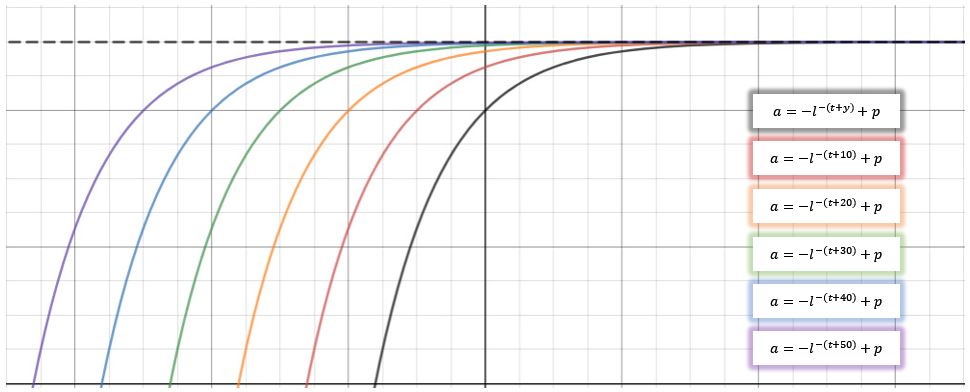
Got that? Let’s push it even further… I am a 23 year old, I have done a star jump before. I have done many star jumps throughout my life. So in my pursuit of the perfect star jump I have got a pretty good starting point because I already have some of this prior knowledge. So what if a newborn baby decided to set out on the same challenge to achieve the perfect star jump? They have never done a star jump before… they have go to learn to do that. They have never done a jump before… so before learning to do a star jump, they have to learn to be able to jump at all. They have never stood upright before… so before they can learn to jump, they need to be able to stand. And no, I am not writing this to have a dig at babies; I am trying to illustrate that our prior knowledge is variable, and in most cases will vary with our age and experiences. So now lets add in our variable of age (y), and look at how variations in age (y) affect our ability (a) at the point where we begin our new skill (t=0). Without debating whether abilities start at birth, conception or even earlier than that, on this graph, the point where a=0 represents the point at which all global ‘abilities’ start.
Ok, you may have noticed my use of ‘l’ as a base.
‘Why l?’ you ask…?
I will tell you why:
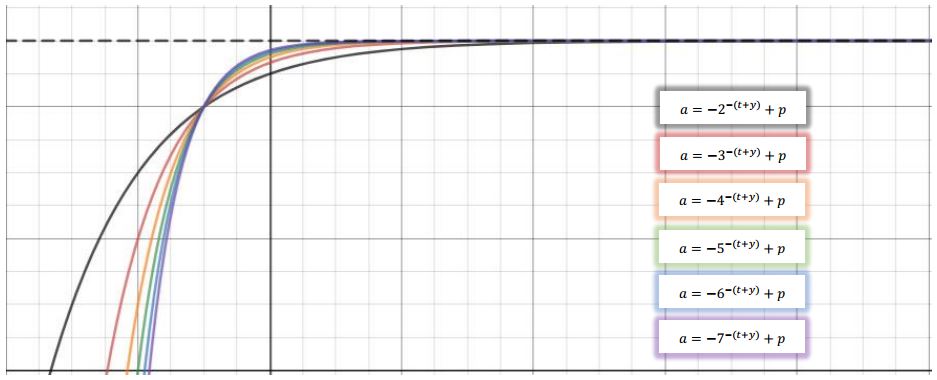
Humans being the complex multivariate beings that we are, we all learn at different rates. Some people have a natural affinity for learning; the take in information, store it and apply it with enviable ease. Others struggle. So if l represents our ‘natural ability to learn’, with higher values signifying a greater ability to learn, look at how variations in l effect the rate of our inverse exponential growth and the point at which t=0.
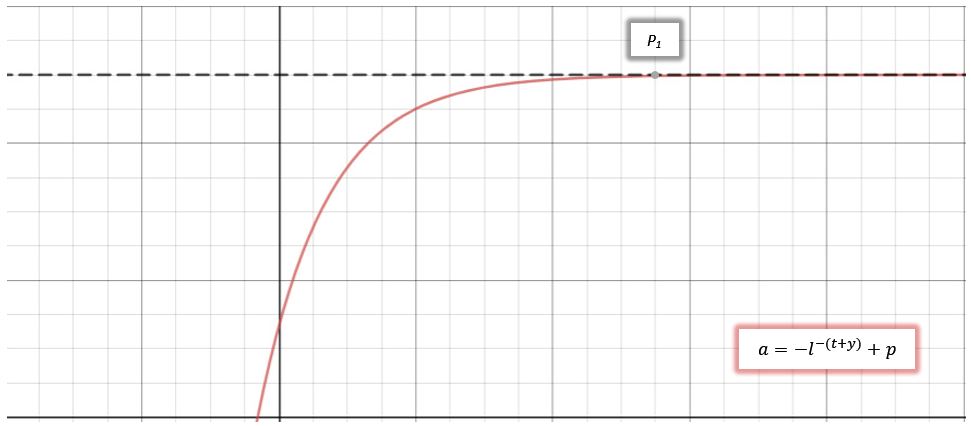
Now, let’s go back to discussing what ‘perfection’ is. Perfection is a very individualised construct, and whether we have reached perfection or not is essentially down to personal perspective. Look at the graph below; looking at this we can mostly agree that by P1 the subject of the graph is ‘practically perfect’.
Now compare it to this graph, and we can probably agree that there is still quite a way to go to reach perfection.
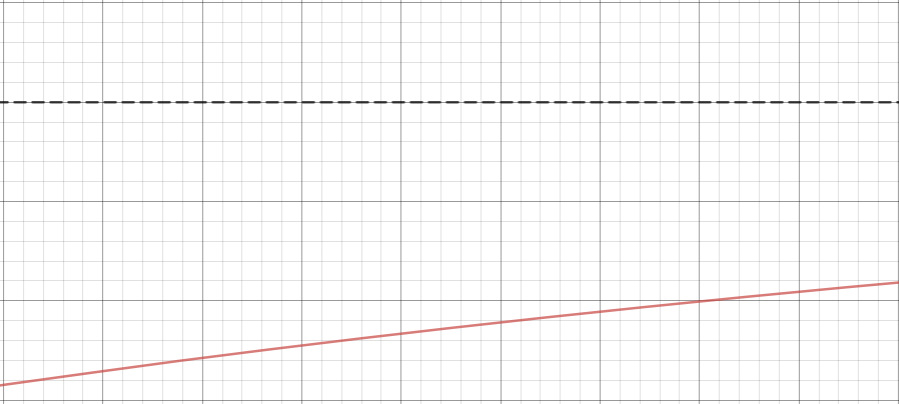
But both these graphs are showing the same point on the same curve, just different perspectives. Ever get that feeling where the more you learn about a topic, the less you feel you know? That’s this perspective difference. When you are so ‘close’ to something, it feels like you are far away from reaching perfection. It feels like there is so much to learn, and it feels like you are not making any progress. But when we take a step back, we realise that actually we are very able, we know a lot, and we are ‘practically perfect’. Neither perspective is wrong, neither is better or worse than the other. They are just different. And so, it is important that we don’t get stuck in one perspective and forget about the other.
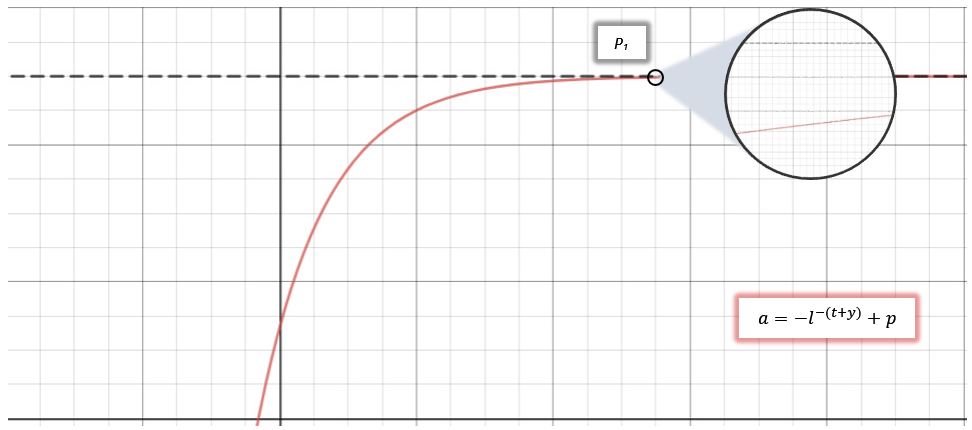
So, my take home message is that absolute perfection is not possible. There is nothing wrong however, with striving for continual improvement, provided we take a step back now and then to see what we have already achieved.
But where does this analogy fall short? Firstly, when we vary l, you may notice that the point at which a=0 varies. To be frank, I have no analogy for this and no simple way to compensate. I need to think about this and may update in the future if I can think of a better way to explain or model it.
Another issue is the model currently doesn’t consider is how learning ability varies with age. Whilst we often see cognitive decline with age, it is still unclear whether learning ability declines or not. But also, some skills such as language acquisition are thought to have a ‘cut off point’, after which our learning ability becomes limited.
Finally, it is important to remember that humans are messy. We are not neat little mathematical equations, we have confounding factors and extraneous variables. We have good days and bad days. So our pursuit of perfection will never look as neat and perfect as this model, but it is that messy variation and unpredictability that makes humans so much more fun!